
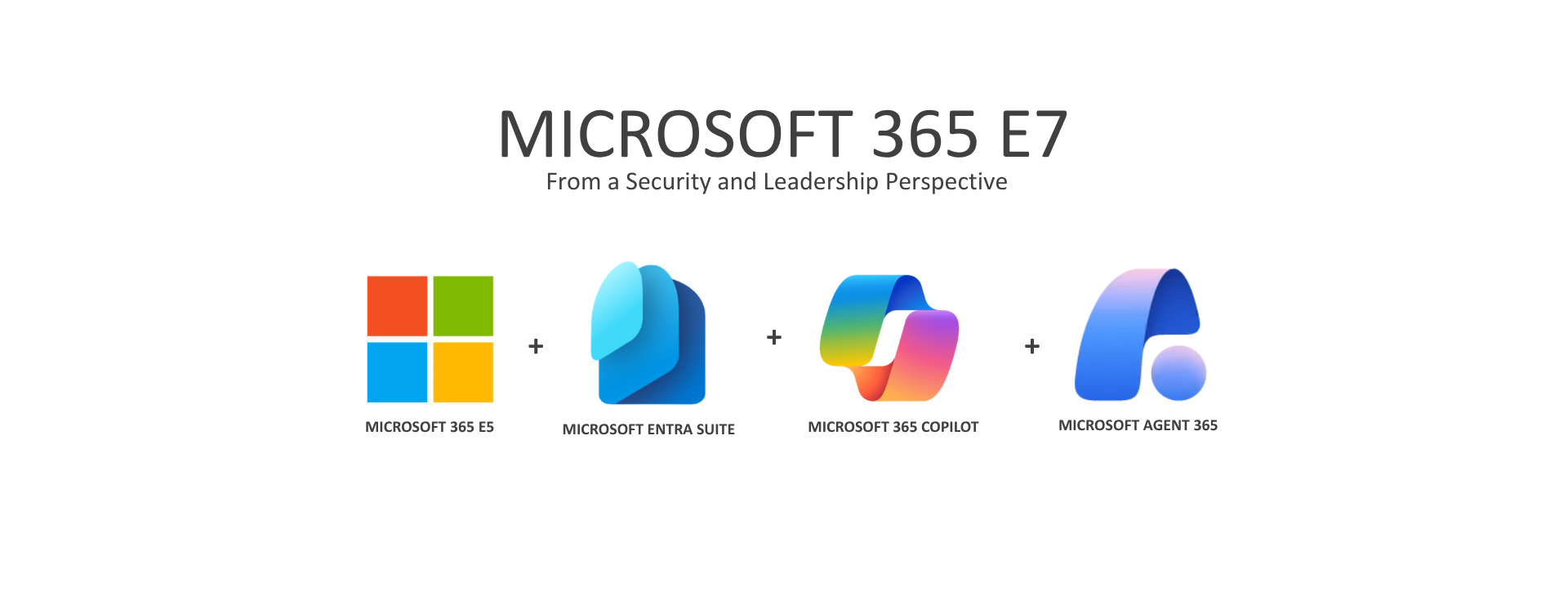
Microsoft 365 E7 from a Security and Leadership Perspective
Microsoft has introduced Microsoft 365 E7 at a time when most organisations are still trying to get value out of E3 and E5. On the surface, Microsoft 365 E7 looks like a bigger license. A more expensive bundle. Another step up the Microsoft ladder. But from a security and leadership perspective, it is something else entirely.
Microsoft 365 E7 represents Microsoft’s shift towards an AI-ready enterprise operating model, where work is no longer done only by people. And that changes how CISOs and CTOs need to think about identity, risk, and control.
What is Microsoft 365 E7?
Microsoft 365 E7 is Microsoft’s latest enterprise license, often referred to as the Frontier Suite.
It combines:
- Microsoft 365 E5
- Microsoft 365 Copilot
- Microsoft Entra Suite
- Microsoft Agent 365 (AI agent control plane)
Instead of buying these separately, Microsoft 365 E7 brings them together into a single offering designed for organisations preparing for AI-driven operations.
Microsoft Agent 365 introduces a control layer that allows organisations to observe, govern, and secure AI agents at scale
What Does Microsoft 365 E7 Include?
Microsoft 365 E7 builds on the strong foundation of E5 and extends it into AI, identity, and governance.
1. Productivity and Collaboration
- Office apps, Teams, SharePoint, OneDrive
- Enterprise communication and knowledge sharing
2. Security (Microsoft Defender Suite)
- Endpoint, identity, email, and cloud protection
- Extended detection and response (XDR) across the estate
3. Identity and Access (Microsoft Entra Suite)
- Conditional Access
- Identity Governance
- Privileged Identity Management
- Lifecycle and access controls
4. Compliance and Data Protection (Microsoft Purview)
- Data Loss Prevention
- Insider Risk Management
- eDiscovery and audit capabilities
5. AI Layer (Copilot + Agent 365)
This is where Microsoft 365 E7 fundamentally changes the model.
- Copilot embeds AI into daily work across documents, email, meetings, and data
- Agent 365 introduces governance and control for AI-driven actions
Together, they enable organisations to move from:
User-driven work to AI-assisted and agent-driven work
Microsoft 365 E7 Pricing: What Leaders Should Consider
Microsoft 365 E7 pricing is positioned above E5, reflecting the inclusion of Copilot, Entra Suite, and Agent 365.
But focusing only on cost misses the point.
The real question is: Are you ready to operationalise AI across your organisation?
Because without readiness, E7 becomes an expensive underutilised investment
The Real Shift: From Users to AI Agents
Most discussions around Microsoft 365 E7 focus on features or licensing. That is not where the real change is. The real shift is that ‘Your organisation is no longer made up of just human users’.
With Copilot and Agent 365:
- Work can be initiated by humans
- Interpreted by AI
- Executed by agents
This introduces a new operational layer:
AI agents acting within your enterprise environment
And for leadership, that creates entirely new challenges.
What CISOs Need to Understand About Microsoft 365 E7
1. Identity Now Includes AI Agents
Identity has always been the control plane in Microsoft environments through Zero-Trust Principels.
With Microsoft 365 E7, identity extends beyond users and service accounts to include AI-driven agents.
This raises critical questions:
- How are agents authenticated?
- What permissions do they inherit?
- How do you enforce least privilege for non-human identities?
2. Data Exposure Risk Increases Significantly
Copilot and AI agents operate across Microsoft Graph, accessing:
- Emails
- Documents
- Chats
- Meetings
If your data is not properly governed, classified, and secured, AI will surface it instantly.
3. Agent 365 Introduces a New Governance Requirement
Agent 365 acts as the control plane for AI agents.
This includes:
- Registration and lifecycle management of agents
- Policy enforcement
- Activity monitoring and audit
- Integration with identity, security, and compliance layers
This is not optional. Without governance, AI agents become unmanaged actors in your environment.
4. Least Privilege Becomes More Complex
Traditional models assume:
- A user requests access
- Access is granted
- Activity is performed
With AI:
- Data is aggregated dynamically
- Context expands automatically
- Actions can be executed beyond original intent
This makes least privilege harder to enforce in practice.
5. Audit and Accountability Are Redefined
In a traditional model:
- User performs action
- Action is logged
In an AI-driven model:
- User prompts
- AI interprets
- Agent executes
A question arises: Who is accountable for the outcome?
This is one of the biggest gaps organisations need to address.
What CTOs Need to Consider
Microsoft 365 E7 is not just a license upgrade. It represents a shift in how your organisation operates. You are introducing AI-driven workflows, automation at scale, and a growing dependency on the quality of your data. This is not about adding new tools. It is about changing how work is created, executed, and managed across the business.
That makes your data the foundation. AI will not fix a poorly structured environment. If your tenant has weak governance, no classification, or uncontrolled data sprawl, Microsoft 365 E7 will simply amplify those issues. The same applies to adoption. Deploying the technology is the easy part. Real value only comes when there are clear use cases, proper enablement, and governance frameworks guiding how it is used.
Cost also needs to be viewed differently. Microsoft 365 E7 may appear expensive on paper, but the real risk lies elsewhere. Paying for advanced capability without using it, or introducing AI without control, creates both financial and operational exposure. The value is realised when processes become more efficient, decisions are made faster, and risk is reduced in a measurable way.
Microsoft 365 E7 vs E5: What’s the Difference?
| Area | E5 | Microsoft 365 E7 |
|---|---|---|
| Productivity | Included | Included |
| Security (Defender) | Included | Included |
| Compliance (Purview) | Included | Included |
| Identity | Entra ID P2 | Full Entra Suite |
| Copilot | Add-on | Included |
| Agent 365 | Not included | Included |
| AI capabilities | Limited | Core capability |
The difference in Microsoft SKUs is no longer just about features. It is about governed AI layer as a default.
The Real Gotchas with Microsoft 365 E7
The biggest risks with Microsoft 365 E7 is not technical. It is strategic.
❗ Over-licensing Risk
Many organisations are already underutilising Microsoft 365 E5, yet are now considering E7 because of the AI narrative.
This creates a dangerous pattern.
Instead of extracting value from what is already licensed, businesses move up the stack expecting the new license to solve existing gaps. In reality, those gaps are usually around configuration, governance, and adoption. If E5 is not fully operationalised, E7 will not fix that. It will simply increase cost while leaving the same inefficiencies in place.
❗ Governance Gaps Will Be Exposed
Before AI, poor data governance could remain hidden for years.
Files were scattered, permissions were inconsistent, and sensitive data often lived in places it should not. But discovery was manual, so the impact was limited.
With Microsoft 365 E7, that changes immediately.
AI will surface, summarise, and connect data across the organisation in seconds. That means anything misconfigured, overshared, or unclassified becomes visible and usable. What was previously a passive risk becomes an active one.
❗ Expanding Attack Surface
Microsoft 365 E7 does not just add new tools. It expands how data and actions flow within your environment.
This happens through:
- Increased data accessibility across workloads
- AI-driven aggregation of information
- Automated or agent-assisted activity
The attack surface becomes less about endpoints and more about context and access paths. Threat actors no longer need to break in the traditional way. They can exploit over-permissioned identities, poorly governed data, or AI-assisted workflows to move laterally and extract value.
This makes visibility and control far more complex than before.
❗ Skills Gap
Most IT and security teams are well trained in infrastructure, identity, and endpoint security.
Very few are prepared for what Microsoft 365 E7 introduces.
This includes:
- Governing AI-driven behaviour
- Managing the lifecycle of agents
- Understanding how data flows across AI-assisted processes
- Applying security controls beyond traditional access models
Without these skills, organisations risk deploying advanced capabilities without the ability to control or monitor them effectively.
Who Should Consider Microsoft 365 E7
Microsoft 365 E7 makes sense for organisations that:
- Are already using E5 effectively
- Have strong data governance foundations
- Are actively investing in AI adoption
- Have mature security and compliance frameworks
It is not suitable for:
- Organisations still struggling with basic security
- Low adoption environments
- Businesses without governance maturity
Microsoft 365 E7 is not just another license. It represents a shift in how organisations operate, how data is secured, and how work is managed in an AI-driven environment.
The conversation is no longer about whether you need Microsoft 365 E7. The real question is whether your organisation is ready to govern a world where both people and AI are working side by side. Because with Microsoft 365 E7, work is no longer carried out by users alone. It is shaped by a combination of human intent and AI-driven execution.