

Microsoft Agent 365: What It Is and Why It Changes How We Govern AI
Microsoft Agent 365 is quickly becoming one of the most important additions to the Microsoft ecosystem, yet most organisations still do not fully understand what it is or why it matters.
For the past couple of years, businesses have focused on how AI tools like Copilot can support users. However, that is already changing. AI is no longer just assisting work. It is starting to take actions, interact with systems, and operate on data.
As a result, this shift introduces a new challenge. It is no longer about productivity. It is about control.
Microsoft Agent 365 exists to solve that problem. Microsoft positions Agent 365 as a control plane to observe, govern, and secure AI agents across environments.. It provides a way to govern, secure, and monitor AI agents operating across your environment. For CISOs and CTOs, this is where AI moves from opportunity to responsibility.
This also ties into Microsoft’s broader enterprise direction with Microsoft 365 E7, where Agent 365 is included as part of a complete AI-ready operating model. If you are exploring how these capabilities come together from a security and leadership perspective, it is worth understanding how E7 brings identity, security, and AI into a single framework.
What is Microsoft Agent 365?
At its core, Microsoft Agent 365 is not about building AI. It is about managing it.
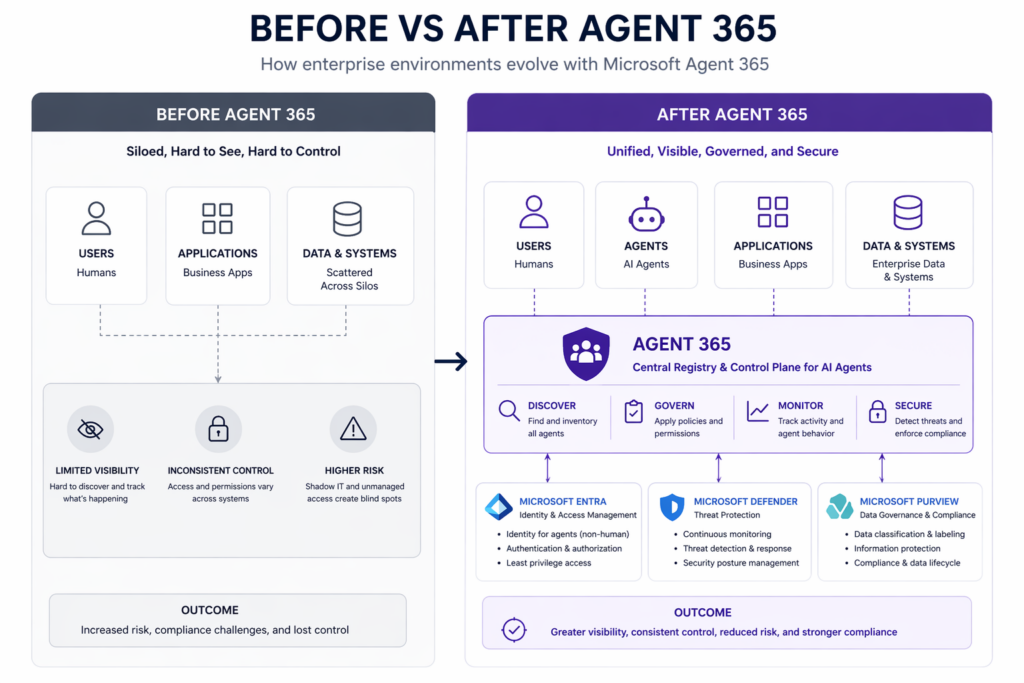
It provides a central way to discover, control, and monitor AI agents across the organisation. Instead of AI operating in isolated pockets, Agent 365 brings it into a governed model where visibility and control are built in from the start.
The easiest way to think about it is simple. Until now, organisations have been managing users, devices, and applications. With Agent 365, they now also need to manage agents that can act on behalf of those users. These agents are not passive. They can access data, trigger workflows, and interact across systems, which means you need to treat them as real actors within your environment.
To manage that effectively, that requires identity, access control, monitoring, and accountability. Agent 365 introduces that structure.
Microsoft Agent 365 vs Copilot: What It Is Not
There is a lot of confusion around where Agent 365 sits, and that is important to clarify.
It is not Copilot, and it is not where agents are created. Tools like Copilot Studio are designed to build and deploy agents. Agent 365 exists above that layer.
Its role is to govern what has already been created.
It answers questions that are often overlooked early on. Should this agent exist? What access should it have? Who owns it? What risk does it introduce? Without a layer like this, AI adoption becomes fragmented very quickly, with agents operating in ways that are not fully understood or controlled.
Why This Exists Now
AI agents introduce a new kind of sprawl that most organisations are not prepared for.
In a traditional environment, there was a clear model. You had users, devices, and applications, and teams could govern each of these through identity and access controls. Agents break that model. They can be created quickly, operate across multiple systems, and in some cases exist without clear ownership or visibility.
This is where organisations start to lose control.
Microsoft Agent 365 introduces a central registry that allows organisations to discover and track all agents, whether they are built internally, provided by Microsoft, or introduced through third party integrations. That visibility becomes the foundation for governance, because without it, there is no way to enforce policy or manage risk effectively.
How Microsoft Agent 365 Changes the Operating Model
More importantly, what makes Agent 365 important is not just what it does, but what it forces organisations to rethink.
The operating model shifts from managing human activity to managing a mix of human and non-human actors working together. That shift touches identity, security, and governance at the same time.
Agents need identities so they can be authenticated and controlled. This aligns closely with Microsoft’s Zero Trust approach, where identity becomes the primary control plane. They need permissions that align with least privilege principles. Their behaviour needs to be monitored, because their actions are not always predictable in the same way as user activity.
This is where integration across Microsoft Entra, Microsoft Defender, and Microsoft Purview becomes critical. Identity defines what an agent can access. Security ensures that behaviour is monitored and risks are detected. Governance ensures that data is used appropriately and remains protected.
Together, these layers create a controlled environment where AI can operate without introducing unmanaged risk.
To understand this shift more clearly, it helps to visualise how Agent 365 sits within the broader AI operating model.
The Real Shift: From Visibility to Accountability
One of the most important changes Agent 365 introduces is around accountability.
In traditional systems, you can usually trace actions back to a user or a system. With agents, that line becomes less clear. A user may initiate something, AI may interpret it, and an agent may execute it.
As a result, that creates a gap.
Who is responsible for the outcome?
Agent 365 helps bridge that gap by linking agents to ownership, tracking their activity, and providing visibility into how decisions and actions are being carried out. It does not remove complexity, but it gives organisations the tools to manage it in a structured way.
Where Most Organisations Will Struggle
The biggest challenge with Agent 365 is not the technology. It is the current state of most environments.
Many organisations are still dealing with unstructured data, inconsistent governance, and limited visibility across their workloads. Introducing agents into that environment does not solve those problems. It brings them to the surface much faster.
Data that was previously hidden, becomes visible and accessible. Permissions that were loosely managed start to matter more. Gaps that were manageable before become active risks.
This is why readiness matters more than capability.
What CTOs and CISOs Should Be Thinking About
From a leadership perspective, the conversation should not start with features. It should start with control and readiness.
Organisations need to think about whether they are prepared to treat agents as identities within their environment. They need to understand what data those agents can access and how that access is governed. They also need to consider how they will monitor behaviour, respond to risk, and maintain accountability over time.
These are not small changes. They require a shift in how technology, security, and governance teams work together.
Many of these considerations become even more relevant when evaluating Microsoft 365 E7 as part of a broader AI adoption strategy.
In practice, managing agents requires a lifecycle approach, not just deployment.
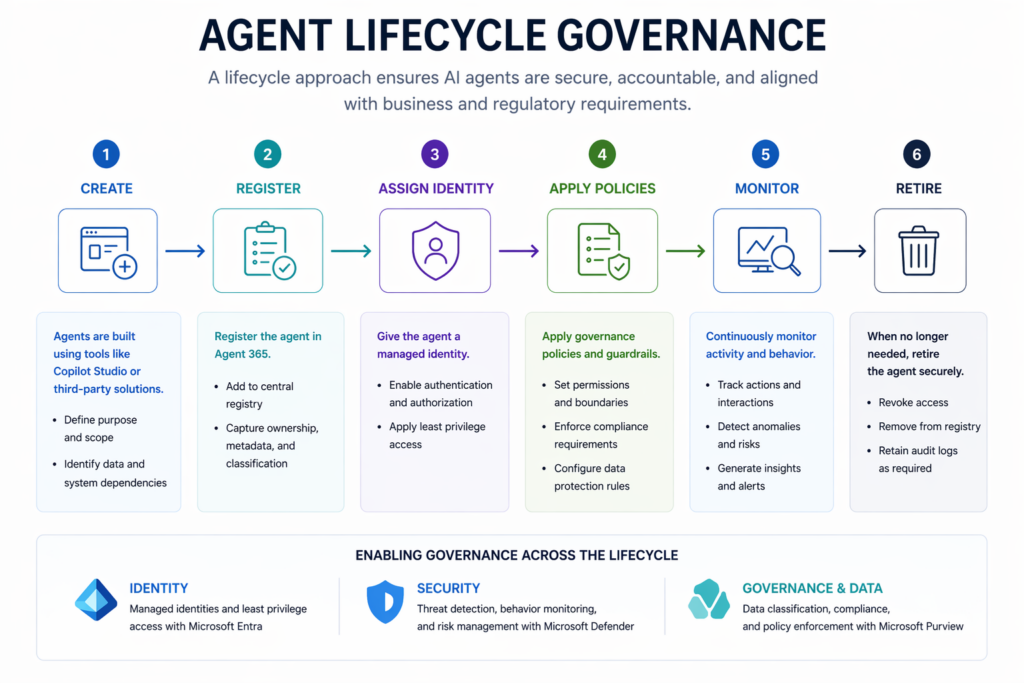
This lifecycle model highlights how organisations need to think beyond deployment and focus on continuous governance, monitoring, and control.
Microsoft Agent 365 is not just another addition to the Microsoft stack. It represents a shift in how organisations think about governance in an AI-driven world.
For the first time, it is not just about managing people, devices, and applications. It is about managing intelligent agents that can act independently within your environment.
The question is no longer whether AI will become part of the workplace. It already has.
The real question is whether organisations are ready to govern a world where work is done by both humans and agents, together.